Modernizing Legacy School Intercoms: A Phased IP Migration Guide for District IT & Facilities Directors
Marketing Team
Blog
Teq Supports District Implementation: Beyond funding guidance, Teq provides turnkey grant alignment, hardware staging, and certified PD coaching via OTISpd.com to ensure 100% classroom adoption.
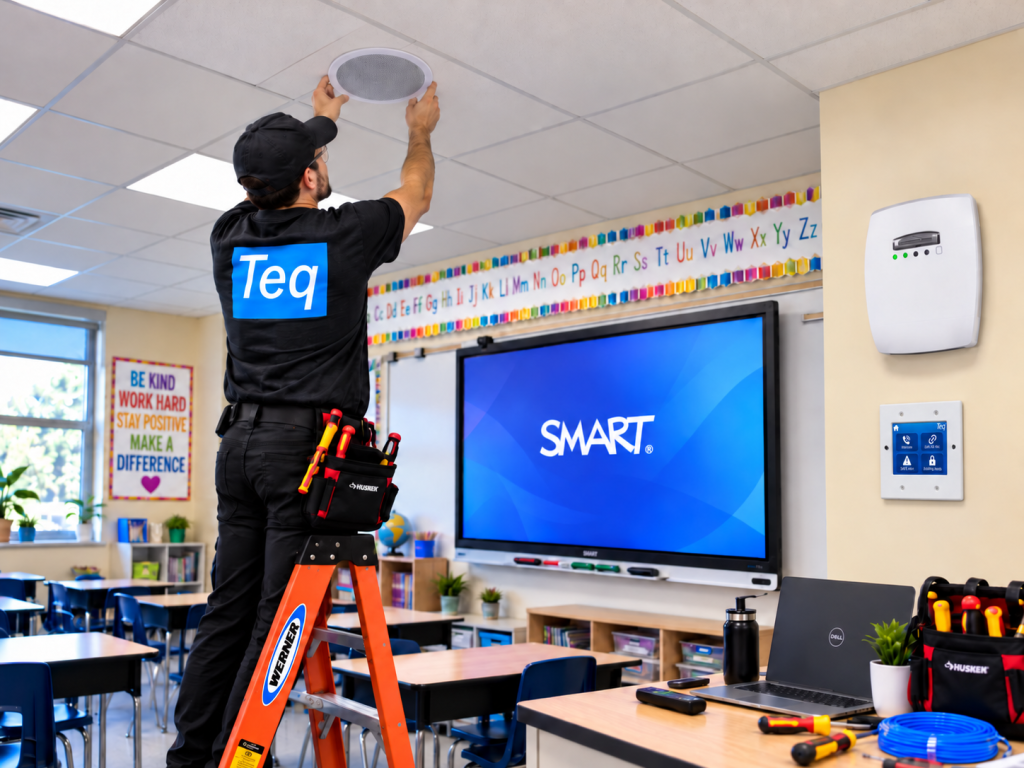
Morning announcements and the Pledge of Allegiance still crackle through the same analog speakers that were wired into your school buildings thirty years ago. For routine daily bells and paging, your existing setup of analog amplifiers, copper cabling, and analog speakers can get the job done.
During an actual campus emergency, however, analog (legacy) intercoms show their limits fast. They cannot communicate with your IP network, trigger building-wide visual alerts, or give teachers, administration and even students (if you choose) instant two-way communication when every second counts. Modernizing your PA system is no longer just a facilities maintenance project, but instead it is a critical part of safely and effectively utilizing technology throughout the entire school.
Here is the catch every superintendent and business official knows too well: a full “rip-and-replace” overhaul can easily run hundreds of thousands of dollars per building. Worse yet, pulling new wire creates a massive headache for teachers, students, and administration. Fortunately, schools have a much smarter option, by taking a hybrid approach. Schools can leverage their existing 70V speakers, and convert digital signals to analog paging devices, VoIP/SIP integration, and one-touch emergency lockdown triggers.
What is a Hybrid IP Intercom Migration? A hybrid IP-Analog intercom migration is a practical infrastructure upgrade that uses IP-to-analog gateway devices to connect to your existing analog speakers. Instead of paying contractors to tear out miles of perfectly good copper wire and passive speakers, your district simply swaps out the clunky analog head-end equipment in the wiring closet for SIP 2.0-compliant IP amplifiers.
For schools, savings can be huge. Take Montauk School District, for example. When they tackled a hybrid intercom retrofit, they reused existing analog speakers, and modernized the system, saving thousands, compared to a full replacement.
The 3-Phased Guide to IP Migration You do not have to overhaul every building over a single summer break. Breaking the rollout into three manageable phases lets IT and facilities directors stretch capital budgets while delivering immediate safety upgrades on day one.
Phase 1: Core Head-End Modernization & Gateway Bridging Swapping out Analog (legacy) stations for IP-to-analog gateways is the fastest way to upgrade campus safety. The gateway is wired into your existing speaker home runs. The analog speaker has no idea where the audio signal started. It plays crisp and clear analog output, driven by your new IP-managed device.
Phase 1 gives your buildings:
• An easy bell schedule and/or change: Web-based bell scheduling and quick zone changes for state testing days, assemblies, early dismissals, or any reason, without calling a technician.
• Flexible paging: SIP VoIP phone extension paging straight from front-office handsets or an administrator’s mobile app.
• Instant SAFE alerts: (If license is purchased by school) With one touch of a button, or a teacher’s mic, will trigger a safety notification. These devices can also be programmed for entire school lockdowns.
Phase 2: Common Zone Areas & Visual Endpoints Anyone who has ever tried to hear an afternoon announcement over a packed middle school cafeteria knows that standard ceiling speakers only go so far. High-noise spaces and large gathering areas need both audio and visual messaging, so both are heard and seen. In Phase 2, focus on your loudest spots: cafeterias, auditoriums, gyms, busy hallways, and outdoor athletic fields.
In these zones, schools can bring in PoE+ IP devices, speakers, high-decibel speaker arrays, and HD monitors. Pairing clear voice prompts with synchronized, color-coded visual strobes (like red for lockdown or amber for shelter-in-place) or displays keeping everyone informed and helping your buildings meet both ADA compliance and NFPA mass notification standards.
Phase 3: Converged Classroom Audio & Instructional Tech Phase 3 brings your safety intercom and daily classroom instruction together into one system. When teachers wear a Pendant microphone, their voice carries evenly to every corner of the room without them having to strain over the hum of HVAC units. At the same time, the classroom’s heart (IP Device) unit is a two-way IP intercom endpoint, hands-free response terminal, silent emergency panic button and much more!
In a real crisis, those saved seconds matter more than anything. FBI active shooter data analyzed by AtlasIED shows that 69.8% of verified incidents ended in five minutes or less, and 36.5% were over in under two minutes. Think about the time it takes for a teacher to walk across the room, pick up a wall handset (phone), and wait for the front office to reply to a call. Putting a single-touch duress button right on the teacher’s wearable microphone cuts out that dangerous delay when every second counts.
Overcoming Budget Constraints: Strategic Grant Alignment* With ESSER funds in the rearview mirror, finding money for infrastructure upgrades takes a bit of creative grant stacking. Fortunately, districts can still tap into several federal, state, and local funding streams to cover the cost of modernizing school communications:
• E-Rate Category 2: Under the FCC FY2026 Eligible Services List and current E-Rate program rules, Category 2 helps pay for the underlying network backbone (including managed PoE switches, routers, and cabling) at up to $167 per student over a five-year budget cycle.
• DOJ School Violence Prevention Program (SVPP): Covers up to 75% in federal matching funds for campus safety gear, emergency communication upgrades, and panic alert tech.
• State School Safety Grants: A great fit for covering non-E-Rate-eligible intercom hardware, exterior horns, and visual emergency strobes.
The Turnkey Approach: Hardware, Installation, and Educator Adoption Let’s be honest: most school IT teams are already stretched thin keeping student devices online, managing state testing platforms, and fighting off cybersecurity threats. Expecting a lean tech department to also pull low-voltage cable and configure paging gateways across a dozen buildings is a recipe for burnout. Working with an experienced K-12 technology partner like Teq takes that weight off your staff.
Frequently Asked Questions
Turnkey vendors for school district intercom funding and installation? Full-service educational technology partners like Teq provide complete, turnkey support for K-12 intercom and emergency paging modernization. Instead of just shipping boxes of hardware to your loading dock, Teq manages the entire project from start to finish. That includes helping you navigate E-Rate Category 2 and state safety grants, running engineering assessments for hybrid IP/analog gateways, handling certified low-voltage installation, and training your staff. Having one partner own the whole process stops the frustrating finger-pointing between cabling contractors, network admins, and building principals.
We need to upgrade our classroom audio but have no budget, where should we look? When money is tight, a two-part strategy works best. First, use IP-to-analog gateway controllers so you can reuse 100% of your existing classroom wiring and ceiling speakers, which instantly cuts total project costs by 40% to 70% compared to a full rip-and-replace. Second, stack your funding sources. You can use E-Rate Category 2 to subsidize the PoE switches and network backbone, then layer in Title IV-A funds* or state school safety grants to pay for classroom audio and emergency notification endpoints.
What companies sell and install K-12 classroom tech, so my IT team doesn’t have to? Teq offers full white-glove delivery, installation, and configuration for K-12 instructional and safety hardware, taking the installation burden off your district IT team. From procuring and installing SMART Boards, Bells & Paging, along with SAFE (Audio Enhancement systems) to handling low-voltage calling, mounting, and hands-on teacher training, Teq covers every step. That way, your internal IT staff can stay focused on network security and daily district operations with certified technicians.
Who are reliable school district intercom and safety communication upgrade partners? Experienced K-12 technology partners like Teq design campus safety and intercom upgrades specifically for the realities of school buildings. By pairing industry-leading classroom audio and paging platforms, including Audio Enhancement’s EPIC system and Teq’s Bells and Paging solutions, districts get zone-addressable paging, automated lockdown routines, mobile alerts, and instant two-way classroom-to-office communication.
Conclusion Upgrading your district’s aging intercoms does not mean you have to tear open walls, blow up your capital budget, or abandon wiring that still works. A phased hybrid IP migration lets IT and facilities leaders combine the rock-solid reliability of existing analog cabling with the speed and flexibility of modern network safety tools. When you pair smart infrastructure upgrades with hands-on teacher support, utilizing technology in the classroom becomes simpler, safer, and far more effective for everyone in your buildings.
Ready to Modernize Your District’s Intercom and Paging Systems? You do not have to map out your campus safety upgrade alone. Whether you want to audit your existing 25V/70V wiring, explore hybrid IP gateways, or figure out how to stack E-Rate and state safety grants, our team is here to help. Explore Teq’s Bells and Paging solutions or connect with a Teq K-12 specialist today to schedule a no-obligation building walk-through and custom migration plan.
*Disclaimer: Grant rules, funding caps, and eligibility requirements change frequently at both the state and federal levels. School districts should independently investigate and verify all funding sources and program guidelines before making any purchasing decisions.
Related Articles & Other Recommended Reading
Customer Spotlight: Middletown Township Public Library
How One Library Built a Community Hub for Creativity, Connection, and Innovation When people think of libraries, they often imagine books, research, and quiet study spaces. At Middletown Township Public Library, those services remain central to the library’s mission, but today’s visitors can also design custom apparel, engrave personalized gifts, create prototypes, and learn new technical […]

How to Safely Store Your AR/VR Headsets for the Summer
As the school year comes to a close, properly preparing your AR/VR hardware for summer storage is essential to extending the lifespan of your investment. Taking a few deliberate steps ensures that when teachers and students return in the fall, their headsets, controllers, and charging carts will be clean, functional, and ready for classroom use. […]

Teq Tuesdays: Summer PD Lineup
Summer is here, and so are Teq’s annual summer PD sessions! Join us on select Tuesdays in July and August for a variety of engaging professional learning experiences. Our summer PD lineup this year dives into unlocking the full potential of AI and brushing up on core Google Workspace skills. All sessions will be broadcast […]