How to Implement Project-Based Learning (PBL) with STEM Robotics & Makerspace Equipment
Marketing Team
Blog
Teq Supports District Implementation: Beyond funding guidance, Teq provides turnkey grant alignment, hardware staging, and certified PD coaching via OTISpd.com to ensure 100% classroom adoption.
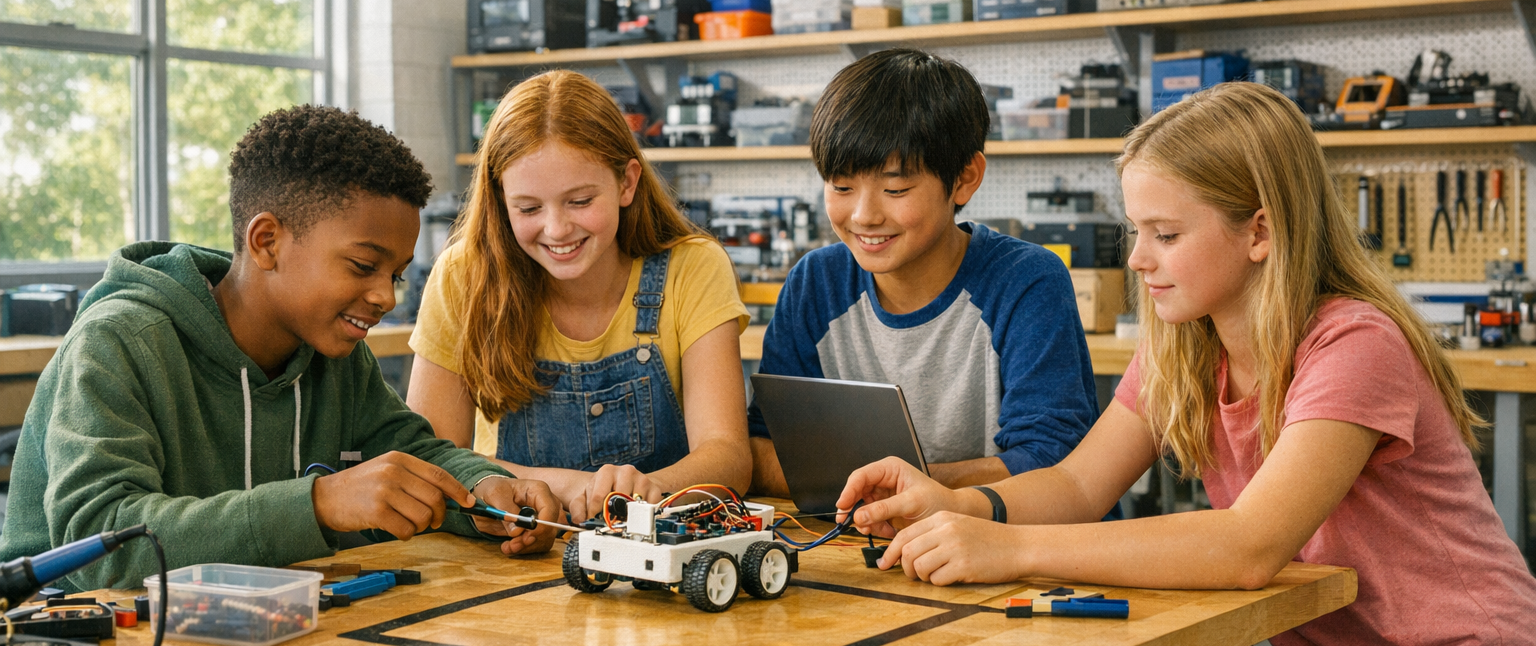
Integrating advanced hardware into K–12 classrooms is a transformative strategy for engaging students, but deploying technology without a coherent pedagogical structure often leads to the dreaded “shelfware” phenomenon. Sophisticated 3D printers, laser cutters, and microcontroller kits frequently sit underutilized when schools lack a clear integration strategy. To solve this challenge, educators are increasingly pairing educational technologies with Project-Based Learning (PBL). By anchoring classroom coding and physical prototyping within authentic real-world contexts, schools can seamlessly build a highly effective STEAM curriculum that drives academic achievement and student engagement.
What is Project-Based Learning in STEM?
Project-Based Learning (PBL) in STEM is an instructional methodology where students acquire technical skills and academic knowledge by actively exploring real-world problems and designing physical solutions. Rather than learning software or hardware skills in a vacuum, students apply the engineering design process to solve complex challenges. For example, instead of learning block coding as an isolated technical skill, students might use classroom coding to program a smart agricultural system or an automated filtration device, linking technological literacy directly to core science and math standards.
Why Combine PBL with Makerspace Hardware? The Evidence
Academic literature confirms that combining structured problem-solving with educational robotics and physical computing yields measurable benefits across diverse student populations. Recent educational research highlights several key advantages:
-
Mathematics and Proportional Reasoning: Integrating physical robotics into middle school mathematics transforms abstract formulas into concrete experiences. A study by Georgia Southern University (Casler-Failing, 2018) demonstrated that students using LEGO robotics to iterate speed and distance programming saw statistically significant gains in proportional reasoning, particularly among historically low-performing students.
-
Equity for Multilingual Learners: Hands-on computing provides a tactile environment that lowers the affective filter for language learners. Research from The University of Texas Rio Grande Valley (Hardy, 2016) showed emergent bilingual students in a robotics PBL curriculum achieved a 20.1% increase in academic content mastery and a 28.6% increase in English language development, outperforming their non-emergent bilingual peers.
-
School Culture and Attendance: Current data reflects a strong link between hands-on STEAM initiatives and school connectedness. A secondary school study by Bagby (2026) found a statistically significant reduction in chronic absenteeism following school-wide makerspace and PBL adoption.
-
Longitudinal STEM Efficacy: According to a 2024 meta-analysis in the International Journal of STEM Education, educational robotics exerts a moderate-sized positive effect on STEM learning performance. Furthermore, long-term multi-year implementations help elementary students maintain higher science self-efficacy and sustained interest in STEM careers.
4-Step Framework for Implementing Robotics and Makerspace PBL
To successfully implement a technology-rich STEAM curriculum, districts should utilize a structured, four-stage framework that prioritizes pedagogy over hardware.
Step 1: Anchor Projects in Authentic Driving Questions
Effective PBL begins with a compelling, open-ended driving question aligned with learning standards, such as the Next Generation Science Standards (NGSS). For example, a high school module aligned to Earth Science and Engineering Design (HS-ESS3-4, HS-ETS1-2) might ask, “How can we design an automated physical system to monitor and clear microplastics from local waterways?”
Step 2: Scaffold Technology Selection
Hardware should act as an enabler of student creativity, matched carefully to the students’ developmental readiness. Implement a tiered approach:
-
Low-Tech Prototyping: Cardboard construction, craft materials, and 3D pens (e.g., 3Doodler).
-
Physical Computing: Visual block-based platforms progressing to text-based coding (Python/C++) using tools like micro:bit, Makey Makey, and Unruly Splats.
-
Robotics & Automation: Sensor-equipped platforms like BirdBrain Hummingbird, UBTECH, and Wonder Workshop Dash.
-
Digital Fabrication: CAD design (Tinkercad, Fusion 360) paired with FDM/SLA 3D printers (UltiMaker, Formlabs, Bambu) and laser cutters (xTool).
Step 3: Apply the Engineering Design Cycle
Guide students through an iterative design loop: Identify Problem → Research & Ideate → Prototype (Code, Print, Build) → Test & Analyze → Refine. For instance, using 3D printing technology significantly improves comprehension of engineering modeling, allowing students to test structural integrity.
Step 4: Conduct Authentic Assessments
Evaluate both the design process and the final product. Utilize formative rubrics (design notebooks, troubleshooting logs) alongside summative showcases where students pitch their physical prototypes to community stakeholders or at school-wide STEM events.
Grade-Band Strategies for STEAM Curriculum Integration
Implementing hardware-driven PBL requires age-appropriate scoping to ensure developmental alignment.
Elementary School (Grades K–5)
-
Instructional Goals: Foundational computational thinking, spatial awareness, basic algorithm sequencing, and identifying push/pull forces.
-
Hardware Integration: Screen-less or block-based coding tools (Ozobot, Piper, Unruly Splats, BirdBrain Finch, Kubo, Kibo).
-
Project Example: Integrating science and social studies by building water quality testing models using elementary sensors to assess river ecosystem health.
Middle School (Grades 6–8)
-
Instructional Goals: Applying proportional reasoning, understanding variables, calculating rate/distance/time, and physical science energy transfer.
-
Hardware Integration: 3D printing (UltiMaker, MakerBot), microcontrollers, and modular robotics (Birdbrain Hummingbird Robotics Kit, UBTECH, LEGO).
-
Project Example: Designing scale-model energy-efficient Tiny Houses utilizing proportional geometry in Tinkercad and printing components via 3D fabrication.
High School (Grades 9–12)
-
Instructional Goals: Advanced mechanical engineering principles, CTE career pathway alignment (Advanced Manufacturing, Architecture), kinematics, and data science.
-
Hardware Integration: Professional-grade SLA/FDM 3D printers (Formlabs), laser engravers, robotic arms, and advanced sensor arrays.
-
Project Example: Applying biomedical engineering and physics to design, code, and 3D print custom assistive prosthetic devices.
Bridging the Gap: Comprehensive Ecosystem Integration
Hardware without a curriculum is the primary driver of underutilized makerspaces. To navigate this, many districts partner with comprehensive educational technology consultants. Teq provides a turnkey solution that bridges the gap between hardware acquisition and pedagogical execution.
Instead of merely supplying equipment, Teq unites technology with targeted instruction through its proprietary iBlocks PBL modules. These student-led, teacher-guided modules provide customized no-tech, low-tech, and high-tech pathways that align with core K–12 standards and CTE clusters.
To ensure teachers are confident in facilitating these experiences, schools must also prioritize online/onsite/virtual professional development. The OTIS for educators platform pairs seamlessly with these hardware and curriculum investments, offering continuous, on-demand coaching—from optimizing 3D prints to introductory microcontroller programming—guaranteeing that technology catalyzes lasting instructional change.
Conclusion
Fostering a dynamic learning environment requires more than simply purchasing 3D printers and robotics kits. By anchoring technology in Project-Based Learning, educators can transform passive classrooms into active hubs of inquiry and innovation. Whether introducing early classroom coding in elementary school or pursuing advanced manufacturing pathways in high school, a thoughtfully scaffolded STEAM curriculum equips students with the resilient problem-solving skills necessary for the future workforce.
Related Articles & Other Recommended Reading
Teq Tuesdays: Summer PD Lineup
Summer is here, and so are Teq’s annual summer PD sessions! Join us on select Tuesdays in July and August for a variety of engaging professional learning experiences. Our summer PD lineup this year dives into unlocking the full potential of AI and brushing up on core Google Workspace skills. All sessions will be broadcast […]
What AI Tools Are Teachers Actually Using?
While having a variety of AI tools at your fingertips is helpful, the number of options can feel overwhelming. In our OTIS for educators session, “Demystifying AI Tools,” we’ll dive into the top AI platforms being used in education. We’ll uncover their ideal use cases, abilities, and limitations so that you can find the best fit(s) […]

Beat the June Burnout: 7 Low-Stress PD Sessions to Prep for Next Year
The countdown is on! Whether you’re a teacher officially on break or school is still in session, we’re celebrating another successful year. You’ve earned the time off to relax and maintain your skills with OTIS for educators! We’ve got tons of engaging PD courses all year round and have curated courses that will perfectly pair […]