Best Practices for Using AI to Support Differentiation
Rebekah Corace
Curriculum & PD Specialist
News
Teq Supports District Implementation: Beyond funding guidance, Teq provides turnkey grant alignment, hardware staging, and certified PD coaching via OTISpd.com to ensure 100% classroom adoption.
The future is here! Due to the evolution of technology, AI is accessible with the click of a button. AI is now everywhere and is beneficial to students and teachers alike. There is so much you can do with the correct tools and knowledge. Harnessing the power of AI is especially important when it comes to differentiation. Differentiation is the process of tailoring lessons to meet each student’s individual needs, interests, and strengths. As teachers, we have so many students with varying levels. This can easily become overwhelming when trying to plan out lessons and activities that will satisfy every student. Let’s take a closer look at three AI tools that are the best practices for using AI to support differentiation!
Diffit
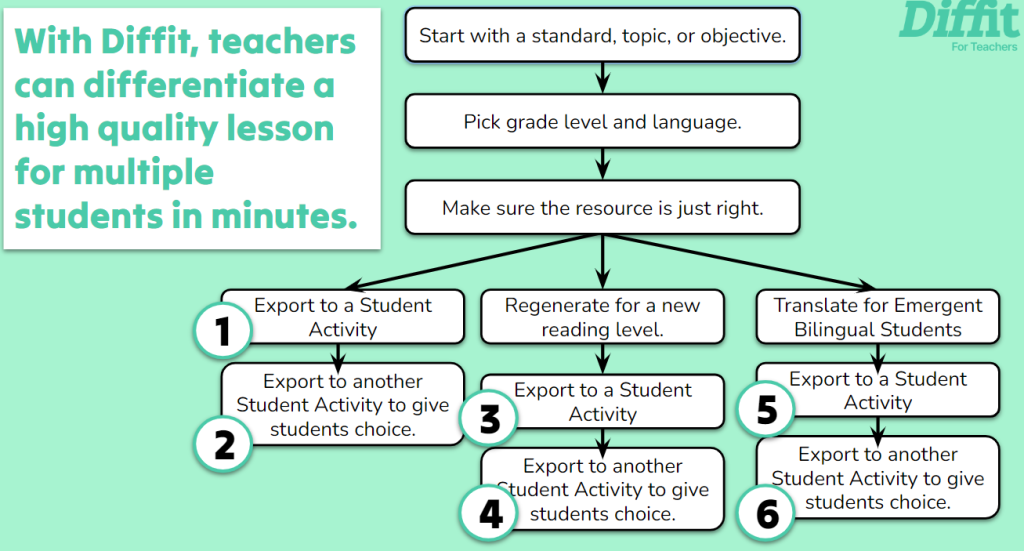
Diffit is an AI tool for teachers to get “just right” instructional materials. There’s a free version for teachers and also a premium subscription option for schools and districts. How do you Diffit? It’s simple, you can use any text, PDF, book, article, URL, or YouTube video to support differentiation, add resources, or extend student learning.
Dive into Diffit!
Another amazing resource within Diffit is the translation feature. You can use this feature to easily convert any text into a different language. Need additional informational texts to bolster your curriculum? Diffit does that too, generating texts on any topic from cited sources. Additionally, you can align lessons to grade–specific ELA, history, and science standards. Easily generate a vocabulary list or other extension activities to use with your students. You can export what you create in Google Slides, Forms, Docs, or PDFs. Diffit also boosts professional development for teachers, as it includes a free year of premium access for all first-year teachers.
Khanmingo
From the makers of Khan Academy comes Khanmigo! This free AI platform is linked directly within Khan Academy. You can choose to use these tools in conjunction with the platform or separately.
Some highlights of this platform include AI tools specifically meant for supporting differentiation, such as “Chunk Text,” “Real World Context Generator,” “Leveler,” “Text Rewriter,” and “Make it Relevant.”
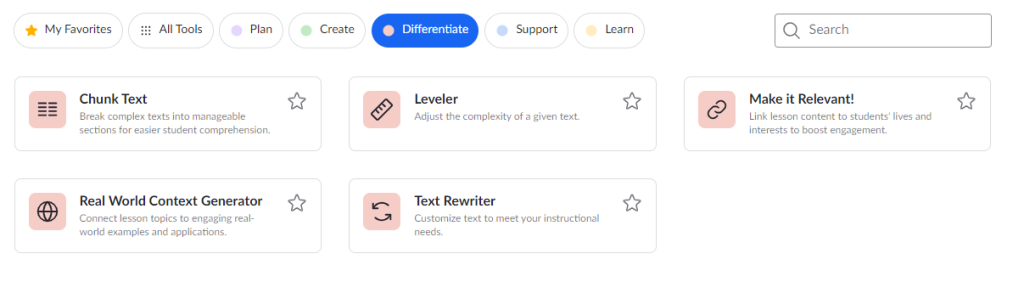
“Make it Relevant” lends itself to differentiation based on student interests. Enter the learning objective and the class profile, outlining student interests in order to generate a list of ideas to use in the classroom.
The tool, “Clear Directions,” comes in handy when you have an assignment prepared but need to give different levels of instruction/directions in order for your students to be successful.
You can chat with Khanmigo about the final product produced and leave feedback so that you receive the best answer possible. Khanmigo also allows you to share, print, or export the end result for you to use in a variety of different ways.
Brisk Teaching
The last, but certainly not least, practice that supports differentiation is the Chrome and Edge extension, Brisk Teaching. You can “Brisk it” to create: presentations, assessments, lesson plans, rubrics, feedback, interventions, and student activities. There are so many things that you can do with Brisk! Get started by installing the extension, pin it to your toolbar, open any Google doc, slide presentation, web article, or YouTube video, and click the Brisk icon. You can also take advantage of “Brisk Bites.” With over 30 bite-sized PD videos, Brisk Bites is designed to teach educators how to use each tool within Brisk!
What makes Brisk different?
One feature that makes Brisk stand out among other AI platforms is the ability to take YouTube videos with closed captions and turn them into Google Slides presentations. From there, you can create a worksheet, vocabulary list, and/or a formative or summative assessment to give to your students. In minutes, you can create a base activity and adapt it to meed varying student strengths/needs. You can then take all of the items you’ve created and create a lesson plan based on the activities produced! Talk about time saving!
Ready to get started?
Use the above to add to your list of teacher resources, and get new ideas flowing. Try various AI platforms to play around and find out how easy it can be to provide high-level differentiated lessons for your students. Teaching encompasses so much; it is essential that you begin using the available tools and technologies that support differentiation. AI is here to make your life a little bit easier and reduce planning time, so tasks don’t pile up.
Also, be sure to check out our accompanying OTIS course, “Best Practices for Using AI to Support Differentiation,” as well as many other AI courses, including a deep dive with “Intro to Brisk Teaching” in the OTIS Course Library.
For more tips, tricks, and tools for teaching in and out of the classroom, check out more content on the Teq Talk blog or our YouTube channels OTIS for educators and Tequipment.
We also offer virtual professional development, training, and support with OTIS for educators. Explore the technology and strategies that spark student success — no matter where teaching or learning are happening!
Follow us on social:
 edteq
edteq  OTIS4educators | Teq Products | iBlocks
  MyTeq
MyTeq  Teq
Teq
Related Articles & Other Recommended Reading

How to Safely Store Your AR/VR Headsets for the Summer
As the school year comes to a close, properly preparing your AR/VR hardware for summer storage is essential to extending the lifespan of your investment. Taking a few deliberate steps ensures that when teachers and students return in the fall, their headsets, controllers, and charging carts will be clean, functional, and ready for classroom use. […]

Teq Tuesdays: Summer PD Lineup
Summer is here, and so are Teq’s annual summer PD sessions! Join us on select Tuesdays in July and August for a variety of engaging professional learning experiences. Our summer PD lineup this year dives into unlocking the full potential of AI and brushing up on core Google Workspace skills. All sessions will be broadcast […]
What AI Tools Are Teachers Actually Using?
While having a variety of AI tools at your fingertips is helpful, the number of options can feel overwhelming. In our OTIS for educators session, “Demystifying AI Tools,” we’ll dive into the top AI platforms being used in education. We’ll uncover their ideal use cases, abilities, and limitations so that you can find the best fit(s) […]